
The Oasiswithin Article Center



THE TROUBADOR
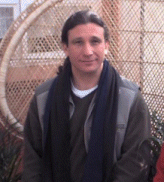
(Paula Marvelly interviews Satyananda)
As I enter the empty Unitarian Church behind the turban domes and lofty pinnacles of the Brighton Pavillion, I see a young man, with his back towards me, seducing the keys of an old and out-of-tune piano. "Who's the composer?" I ask by way of introduction as I approach. Satyananda's playing trails off into silence; meditatively he turns around and smiles. " Don't you recognise it?" His Latin American cadences have their own song-like quality. " It's 'Yesterday' by the Beatles" I blush at my ignorance as he returns to finish the concluding chords.
An extraordinarily featured man, Satyananda is very gracious in his manner, flourishing his hand to a seat where we can talk. His shoulder-length brown hair is swept back into a ponytail, accentuating his feline countenance that tilts ever so slightly as a cue for me to ask about the spiritual understanding I have come in search of. There is a notable lack of homiletic quotations and epigrammatic phrases in his speech. The only theoretical reference Satyananda does make is to the process of Self-enquiry, a technique that he discovered whilst on a silent retreat a few years ago. Indeed, his manner is so relaxed, words flowing out of him with such poetic grace; it is easy to feel spellbound by this advaitic Adonis - his Hispanic lilt hypnotically lulling any devotee into a satisfied restfulness. Narcissism, is not however, on the agenda, Satyananda is just a regular guy. Despite periods of intense suffering during early childhood years and, more recently, a painful divorce, there is no history of a lifelong spiritual journey, no angst-ridden pilgrimages to holy sites. He confesses to never even having been to India.
Bernardo Lischinsky Arenas was born in Uruguay in 1964 to a Jewish father and a Catholic mother, though there was never much talk of religion at home. He felt that his relationship with God was very much a private affair, engaging in divine tete-a-tetes beyond the protective gaze of his parents. He moved to Venezuela at the age of 12 for " political reasons", performing with them in the streets and art festivals of his hometown in Amsterdam- a fitting profession for the metaphor of seeing the world as a play at the hands of a divine string-puller.
Satyananda's satsang is low key - there are no pictures of great teachers, no flowers, no holy relics, just a beeswax candle effortlessly burning and minding its own business. He currently holds meetings throughout the year across Europe, most specifically in Holland and the UK. There are also plans to set up a commune in the Andes mountains - Alahcanura is a strip of recently purchased land for the specific purpose of holding retreats for three to four months at a stretch. Far removed from technocracy, it would be a return to the life of the land, a place to be at rest, a place to come home.
Satyananda rises from his seat - he has something to show me. We step outside the church. He points to a large plaque majestically hanging on the outside wall.
"This church seeks to encourage and support each person on their spiritual and religious journey and does not ask for commitment to any one particular creed or doctrine."
Paula: Could you speak a little about your family?
Satyananda: My mother was a very interesting lady - she was very much awake. She taught me a lot. She also had some difficulties in life about adapting into society - she was a doctor but she had a nervous breakdown. She had complications in her mind that I had to confront since very early on, and that taught me a lot. I suffered a lot too, but I could see she was teaching me many things. She was showing me how I was. We were always touching the limits and she helped me explore that and go beyond them. I can see that now.
When I was seven, coming back from school, I knew I was late and was going to be punished. I was totally in panic and couldn't almost walk into the house. And suddenly there was this voice, but it wasn't in the way we are speaking now - it was all at once. It was just a direct knowing that it wasn't important. Somehow I knew that it was fake - the punishment, the pain, everything….
In that knowing, I simply allowed myself to go through it, realising that in the future I would laugh. I remember that - it was so clear. So the fear was gone. I went into the house and I confronted my father and remembered that he saw in my eyes that I wasn't scared and I wasn't scared. So during the punishment, I was in a state of presence - I wasn't touched by the punishment. For me, that was like finding a safe place where I could hide in, every moment that I was scared or suffering.
We rationalise this process of being present but all we need to do is relax into this state…how does this happen?
I don't know how it works. I asked my father whether he had remembered anything about it and he said, 'Yes, you are the only son that was not scared of me!' I had been scared of him for a long time. I don't know how it happened, but I do know that since that moment, I couldn't take anything seriously any more.
I remembered back at the beginning of the Seventies, my family would often sit at the table and discuss the new "press-a-button" culture, the new technology, and I remember having arguments with them about this. I would say it is only scientific- it won't make you happy. I also remember calling them nobleros, which in Spanish means 'someone who lives in a dream or a novel'
I knew that I wasn't able to adapt to my studies. I didn't want to follow a career. And that inner place never left me. I was in trouble many times but if I could be alone there was a feeling of going in and out of that inner place. Sometimes I would catch myself suffering and then (clicks his fingers) I would suddenly see that it was over. But that wasn't an intellectual process.
After your mother, did you have a spiritual master, so to speak?
When we speak about masters, one of my biggest masters when I grew up was Bob Marley and he still is, because he was speaking about the nature of the mind. He's not just talking about revolution in a political way- his words are very deep and I could always catch what he meant. ' We are coming in from the cold' he used to say. There are many songs I still like - it's pure wisdom. So my master was always appearing in different forms, in different bodies, when it wasn't clear that it was within. Music---my mother---there was always a way of remembering.
It's the same with art. I was talking about art with a musician friend of mine. All the artists - they are trying to express what is inexpressible through their art, and in that place we meet. If you can see a picture in silence, you can see the silence of the painter. Art is always an expression of what we all know. It is a distortion of that which cannot be expressed. It is beyond words and language. There is recognition it's not a learning process. So in the words of Bob Marley, there are plenty of recognitions.
You know, I never read much and didn't get to learn about meditation or spiritual paths until I met my 'spiritual' master. I went to satsang two and a half years ago. I was at the end of a very long process of suffering. It was very deep - I have never suffered so much in my life. It was great! It was excellent! I couldn't have been more down - I was married to a lady and we got divorced. I couldn't work it all out for a long time. But I had an instinct to go into myself. I went to Brazil and stayed on the beach for some months. I gave myself time.
When I was in Amsterdam during the time of my divorce there were advertisements announcing courses of meditation for free. After the course, which lasted for three days, I joined a meditation group and sat in silence with them, twice a week. It used to give me a lot of peace. But I was still living with my wife - we were in the process of separation, so being with the groups was the only place where I could be in silence! I was so grateful to them - they taught me some mantras including the mantra ' OM'. When I went to Brazil, I sang it almost all the time, particularly in the morning when I woke up. I started off saying it 60 times a day, then 70, 80, consecutively up to 120 times and then 110, 100, and back to 60 to start again. It was very helpful to clam down my mind. It became a deep obsession.
I have often heard of people who have reached a peaceful state speak about a period before of intense suffering. It's not necessarily a prerequisite but it is very common.
Yes, for me I knew it was misery but I also knew it was because of something I had caught. I began to believe all the bad things I was telling myself, and so I suffered for it. Somehow I was blaming myself. But somewhere in the corner was silence. It's difficult to explain - the outside expression of it was suffering, but inwardly there was peace. Even the suffering was a way to try to recover that relationship.
When I met my master, I was at the end of that suffering - I was feeling much better within myself. When I went to satsang it was at the beginning of September 1997. I sat down and the first things, which we talked about, I recognised as being true. My master kept talking and for me everything was so clear. There was nothing new. I was there for the whole session - for ten days, I think - but I didn't speak a word while I was there. It was just a reconfirmation, a deep reconfirmation, like drinking when you are thirsty. The answers were in the same place in the same moment. Whilst it was recognition, I never spoke with my master about it. We never had much speech contact.
After satsang, I lived all by myself through the winter in a wooden wagon in the Dutch countryside. I stayed all that time deep within. I knew it was all over. My master brushed everything out. What a remarkable master!
Is it like a process where the mind dissolves?
No, it's not like that, to be silent is your true state, and it is not the absence of noise or absence of thought. Actually when a thought arises, you don't have it - it is not in your department. It's not something you own - it just comes from the same source. If you decide to have a thought, then you are not in silence. Realise the distance between you and the thought - if you can see that, then you realise that you are in silence; from the moment you can investigate the mind and the patterns of thought. The transmission that I received from my master, for which I am eternally grateful, is Self-enquiry.
What my master taught me, what was shown to me, what was explained to me not only in words but also in pure action, was Self-enquiry. That for me was enough to break the cycle of patterns. It's like, if you find out exactly where the problem of an illness is, you go directly to the point, which is the cause of the problem. I realised the importance of Self-enquiry as a process in which we totally neutralise the mind. Instead of finding out what 'I' feels or what 'I' wants or what 'I' learns, I found out that 'I' was not real and all that happens to that 'I' is irrelevant. That is the transmission I received from my master.
I went on a silent retreat - it wasn't really searching. I just received a transmission that I understood and now I want to offer myself in any way for the service for Truth. That's what happens. That's all.
There seems to be a new generation of teachers - a couple of decades ago there were teachers like Ramana Maharshi, Nisargadatta, Papaji, and now we have these troubador teachers, as it were, who have no teaching and don't necessarily have any teachers whom they refer to. Could you speak about this generation? Why it's come about?
No, I cannot speak anything about it. You see, it's been a long time since I asked why! And if I do answer it, I will never know if it is right, so it's kind of wasting words. It just manifests.
I was talking with my aunt the other day - she is a history teacher- and she was saying that in the sixth century before Christ, there was also a time when all the philosophers form the corners of the planet were speaking about these things. All were saying exactly the same thing using different words. It was at the same time as Shankara. If you study the philosophy and you study the tradition of the natives and Indians and Hindus, you will see that they all speak the same. It seems like it comes in waves but why…I don't know.
It seems like we live in times when religion has collapsed - consumerism, materialism - all have collapsed. We don't want to believe in anything, we don't want to follow anybody. It's a new expression. Maybe that's why there are now masters without lineage. We live in different times - technology and communication have allowed us to know what happens in the same moment on the other side of the planet. We have a lot of information and a common feeling that there is emptiness in all that information, so this is why it is happening. That's my impression.
Why is there always a pull to find happiness outside of ourselves? The obvious example that comes to mind is relationships - the desire for sexual and emotional intimacy with other people. We hear the theory that truth is within, but there is such a difference between actually knowing that and experiencing it.
Yes, we never experience what we know. What we call knowledge is always relative - it's intellectual. You see, a child knows that the iron burns so it doesn't touch it. There has been very strong conditioning in our minds, not by teaching but by direct example. The people who brought you up, they have also been conditioned and those who brought them up also. And that conditioning - it is based on a belief that is transmitted beyond words through their example. It's a sense of individuality. When you are a baby, you don't have it. The baby starts to learn about objects - it sees a flower, window, and if you put a mirror in front of him, he will say 'Baby'. The first way in which we call ourselves is 'Baby'. We don't say "I"- we say, 'Baby wants this, Baby wants that.'
But the baby listens to his father and mother saying, 'I', 'I'. 'I', and he starts to create an identification with the body. Instead of seeing an object in the mirror, he starts to see himself as 'I'. He learns this and that moment is extremely powerful because there is now a belief in the limit of 'I'. So there is a direct identification - 'I am this body'. From that moment, all information is reinforcing that idea -' I am fat'; 'I am thin'; 'I am big'; ' I look like my father'; 'I look like my mother' and so on. So this separate identity continues creating itself and as a result, there is a deep feeling of separation.
There is from then on a longing to go back to what the baby was before the feeling of being a separate form. There is a longing because in that moment there was freedom, there was happiness before the form. There is a memory of boundlessness. So the baby grows up, becomes a child and still learns the example, the sense of 'I', the separation. He sees his parents and brothers and sisters and friends at school -everybody's also missing something. There is a natural inclination to go back- there is always a promise. That is why we keep searching outside through the senses. We grow up and never really question ourselves- what is the motivation behind all the desires? All that we want is to be ourselves. That's what we all want - just to be the way we are. We don't want anything else.
The thoughts arise, pulled by the centre of the mind - that sense of 'I' that image of you. It leads your life. It has many thoughts - 'when I get this I will be happy'. I like this example I've read from Poonjaji:' when I buy my new house, I will be happy. So then you buy the new house and you are actually happy but this is not because of the walls that you are happy, it's not because of the material house that you are happy. The happiness is in the absence of the thought, 'I want a house'. The thoughts are gone. And there - you're happy!'
But then another thought will come - you want something else because you want happiness. And so on. I want a boyfriend, I want a relationship - just to find what we already have. So with any thought, if we could simply look for a moment what is beyond it, if we can see what is in between two thoughts just for a second, we experience happiness. When we are in deep sleep we are happy. We like to go to sleep because we find happiness. It's the most simple thing. We are happy because we get rid of thoughts.
There seems to be a very pure impulse in that love arises for certain things or people but then very quickly possessiveness comes in - wanting to hold on to those things. Then the fear of loss and jealousy and all those other connected emotions arise. So then you shut down and try not to experience love at all. It's like a roller coaster of emotions.
Yes, we don't see the source of happiness. We don't see the real source of that love - we think it is coming from outside. The real love is recognition - even the expression of beauty is recognition. When we see something beautiful, it resonates within us. And then there is this belief system in which we think it is coming from outside. You think that if you lost that object or that person, it's going to be gone. There is no foundation into the source of That. So basically, that is what is called to 'know yourself' - to see that You are that source. If you try to solve all that 'I' feels or know or thinks, it's endless. If you simply try to understand that You are not that 'I'…If you look directly into that 'I' and see that it is just a thought, a story, then you are already free. Then you can recognise, then you can experience, without the need for an object.
This possession - desire and jealousy - it happens in the level of mind, to the ego. So if it happens. Ok. You are not going to punish yourself because of that. It happens because it happens - it's a good sign because it's showing you that you are suffering. It is showing you your attachment. So that sign should be enough for you to have this impulse of enquiry - Who am I? is the question that the mind cannot answer. In that impossibility, it stops.
You know, it's like computers - when you put something in that they cannot handle they just lock. You have to call out a professional. The same with the mind. If the mind asks itself, 'Who am I?' it cannot solve it. It cannot solve it because all that it knows is form and name. That which is the source of the mind, is completely beyond form and name so it cannot put it into a box. In that impossibility it just stops.
That which remains as consciousness is You. That is the way home - direct, cutting thorough everything that is there. Passion, fear, pain, whatever. It's very simple really, isn't it.
Yes, it's very simple.
This document maintained by
multifaith@aol.com.
Material
Copyright © 2000 Oasiswithin